

Learning how to choose golf clubs is one of the most important equipment decisions in golf. Many players buy clubs by brand, price, looks or a friend's recommendation. The problem is simple: a club that is perfect for one golfer can be too heavy, too demanding or simply wrong for another.
A good golf club setup does not have to contain the most expensive models. It has to make your typical shots easier. For beginners that means more forgiveness and an easier launch. For improving players it means better distance gaps and more control. For ambitious golfers it means fine-tuning head, shaft, loft, lie and grip.
Club type |
Job in the game |
What matters when buying |
Driver |
Long tee shots |
Loft, forgiveness, shaft flex and confidence at address. |
Fairway wood |
Long shots from the tee or fairway |
Easy launch and suitable loft gaps. |
Hybrid |
Alternative to long irons and rescue from rough |
High launch, forgiveness and the right distance gap. |
Irons |
Controlled shots into the green |
Player profile, shaft, length and forgiveness. |
Short game, bunker shots, pitches and chips |
Loft, bounce, grind and spin. |
|
Putts on the green |
Head shape, length, alignment and feel. |
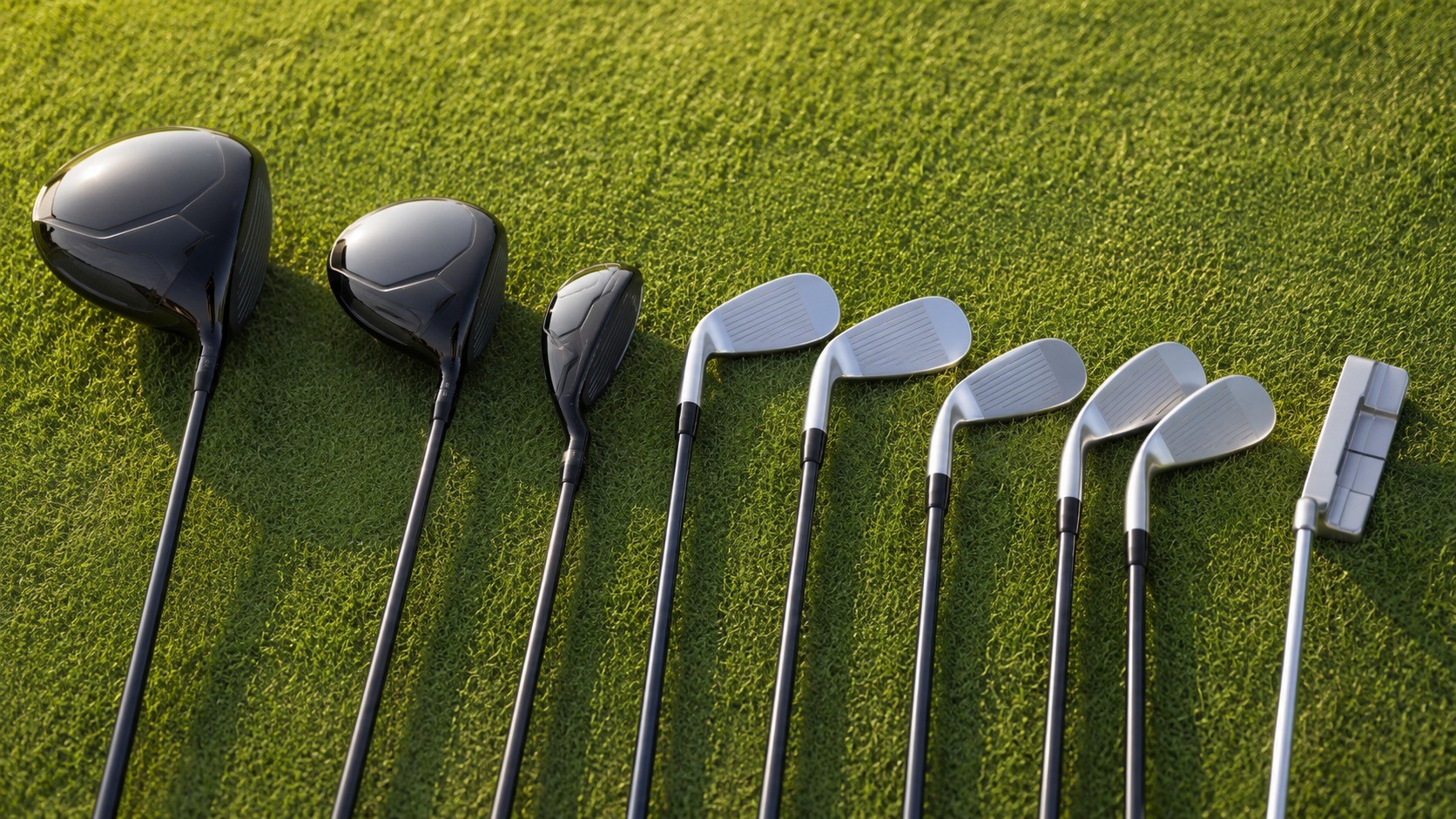
Many golfers copy the maximum allowed setup even though they cannot hit every club with confidence. For beginners, a smaller and logically built set is often better than a full bag with difficult clubs. Clear distance gaps and confidence matter more than owning every possible club.
A practical beginner setup can include a driver or fairway wood, a hybrid, several irons, two wedges and a putter. Improving players can add clubs more deliberately: a second fairway wood, additional wedges or a specialist putter may be useful when they solve a specific gap.
Golf clubs for beginners should help the ball launch easily and should not punish every off-center strike too severely. Larger heads, wider soles, lower centers of gravity and lighter shafts can create more stable results. The main buying idea is simple: the club should help you enjoy the game and build confidence.
Once strike quality becomes more stable, it is worth checking the gaps between clubs. Many players have a gap between fairway wood and longest iron, or between pitching wedge and sand wedge. Hybrids or additional wedges can directly improve scoring when they solve those gaps.
Ambitious players benefit from accurate matching. Shaft weight, flex, length, lie angle, grip size and loft gapping all influence ball flight, direction and consistency. At this stage, it is often smarter to solve specific weaknesses than to buy a complete new set without a clear reason.
A driver is attractive, but not every beginner hits it consistently. A fairway wood or hybrid can sometimes produce better early results because the ball launches more easily and dispersion is smaller. That does not mean beginners should never use a driver. It means confidence from the tee matters more than theoretical maximum distance.
If the driver creates too many penalty shots, you should have a safer option in the bag. A hybrid or higher-lofted fairway wood can be more valuable on tight holes than a driver that flies far but too often finishes out of play.
Irons vary greatly. Game-improvement irons offer more forgiveness, larger hitting areas and often a higher launch. Players irons give better golfers more control and feedback, but they forgive less. Many amateurs buy irons that are too demanding because they look cleaner. For scoring, repeatable contact matters more than appearance.
A useful rule is this: if you often hit thin, heavy or off-center shots, choose more forgiving irons. If you can control flight, spin and strike location deliberately, a more compact iron can make sense.
Many golfers invest heavily in drivers and irons, then treat wedges and the putter as minor details. That is a mistake because many shots happen around and on the green. A wedge setup with clear loft gaps can make pitches, bunker shots and chips easier. A putter that matches your stroke can add confidence on short and mid-range putts.

- Choosing clubs only by brand or because a tour professional plays them.
- Buying irons that are too demanding when forgiveness is needed.
- Ignoring distance gaps in the bag.
- Overlooking shaft flex and shaft weight.
- Thinking only about distance and forgetting control.
- Treating wedges and the putter as an afterthought.
- Which shots currently cost you the most: tee shots, long shots, irons, short game or putting?
- Which clubs in your bag do you rarely use or hit without confidence?
- Do you have distance gaps between two clubs?
- Is your shaft too heavy, too light, too stiff or too soft?
- Do you need more forgiveness or more control?
- Should one club solve a specific problem, or would a complete set be more practical?
The best golf clubs are not automatically the newest or most expensive. They are the clubs that help you produce repeatable results. For many players, that means less complicated clubs, better distance gaps, more confidence and a setup that matches their actual game.
At Digitalgolf.com, you can build your setup through clear categories: drivers, fairway woods, hybrids, iron sets, wedges, putters and complete sets. Do not start with the question, What is the best model? Start with the question, Which club makes my next shot easier?
Which golf clubs does a beginner need?
A beginner mainly needs forgiving clubs: an easy-to-hit wood or hybrid, forgiving irons, a wedge and a putter. A complete beginner set can be a practical solution.
When should I replace my golf clubs?
Replace clubs when they no longer match your skill level, swing speed or distance gaps. Worn grips or old wedges can also be a good reason to upgrade.
Is a fitting useful for amateur golfers?
Yes, especially if you play regularly or struggle with direction, ball flight or consistency. Even simple adjustments to shaft, length, lie or grip can help.
Are expensive clubs automatically better?
No. Expensive clubs often include modern technology, but they must fit the player. A suitable lower-priced club beats an unsuitable premium model.